Mulan
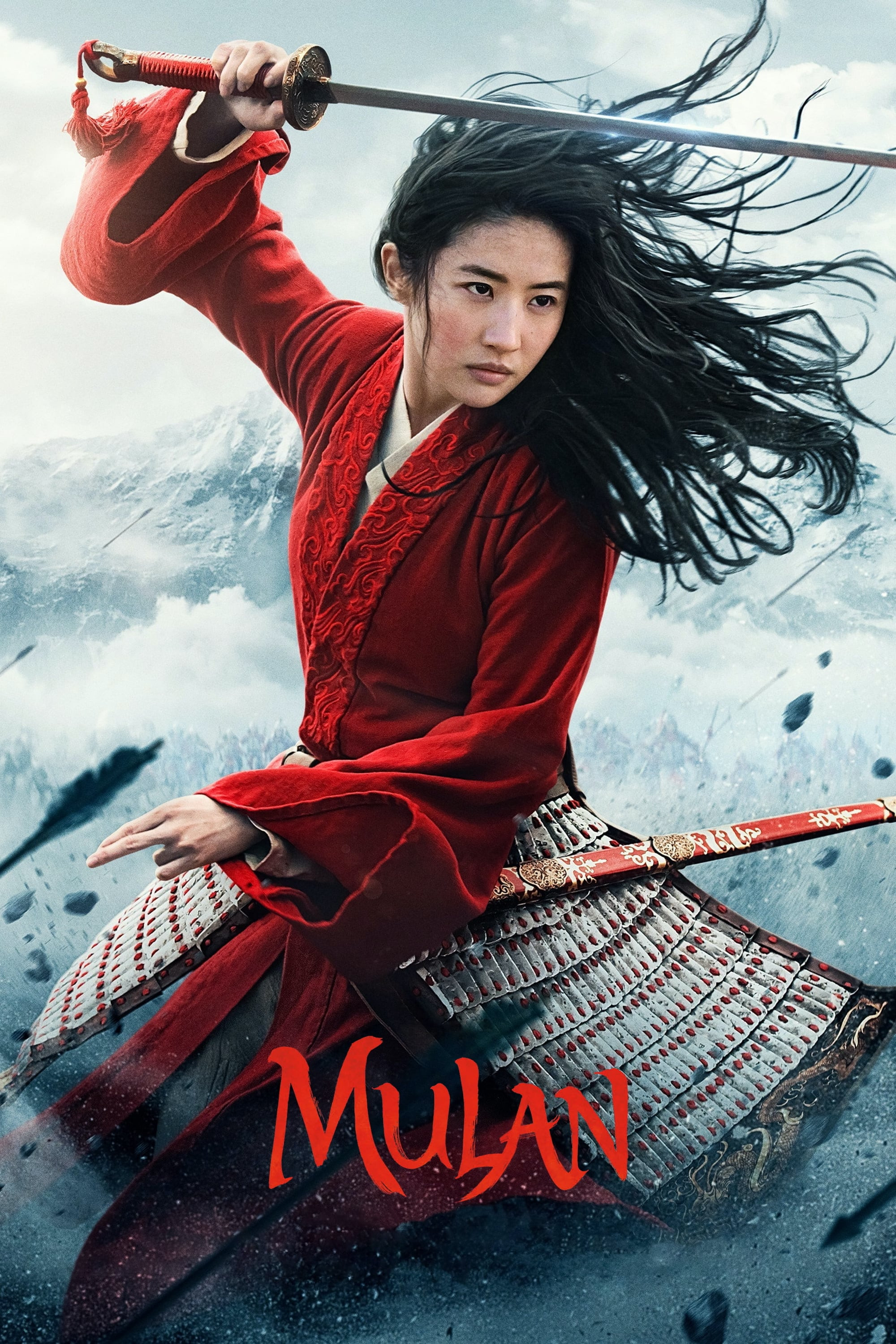
In order to create a martial arts war epic, this live-action adaptation of Disney's 1998 animated hit, which was based on the Chinese ballad of Hua Mulan, eschews romantic humor, talking dragons, and musical numbers. Mulan, a young lady with extraordinary qi energy, assumes the identity of a man in order to replace her sick father in the Imperial Army against the witch-allying Böri Khan's invading Rouran armies.
With a vicious initial village invasion and a pivotal encounter in the Imperial City, the movie skillfully uses kinetic intensity in its combat sequences. Notably, Mulan's calculated avalanche scenario symbolizes both environmental devastation and individual bravery. China's landscapes are expertly captured by cinematographer Mandy Walker, who uses a changing color scheme to evoke a range of emotions. The martial arts scenes highlight Mulan's journey from deceit to mastery by fusing fantasy with actual battle. Emphasizing family values and communal dignity over individualism, themes of female empowerment and filial piety strike a strong chord. Despite being released on streaming services, the film's theatrical ambitions are justified by its rich production design, which pays close attention to cultural details, and its substantial $200 million budget.
Although Mulan's exclusion of musical numbers and Mushu indicates a cogent artistic goal in line with wuxia history, the outcome is inconsistent. Since the instrumental version of "Reflection" lacks emotional depth, its absence prevents us from understanding Mulan's psychology. Although they complicate the main subject of concealment, new components like Mulan's qi talents and the witch Xianniang add legendary intricacy. The movie fails to achieve both authenticity and nostalgia as it tries to strike a balance between respecting Chinese film traditions and Disney brand familiarity. The usage of Chinese instruments is ornamental, while Harry Gregson-Williams's music offers majestic support but is unmemorable. Even with expert execution, the soundtrack lacks unique originality when classic songs are replaced with new compositions that don't have the same emotional impact.
The film undermines emotional ties by sacrificing psychological depth for faster speed. Mulan's quick recruitment is devoid of internal strife or family turmoil, and her bonds with other troops are merely surface-level. The romance with Honghui seems forced, and the movie treats the deaths of fallen allies as cheap story devices rather than expressing true pain. Because emotional scenes like Xianniang's sacrifice and her father's sensitivity aren't well-supported, viewers are left with an outstanding but uninspired encounter. This rendition distances the viewer from Mulan's journey by depicting her as a capable icon rather than a relatable individual, in contrast to the animated version that had real emotional stakes.
With action scenes that respect Wuxia tradition while upholding Disney production ideals, Mulan (2020) succeeds as a martial arts extravaganza and cultural reclamation attempt. Even though its streaming release (exacerbated by pandemic conditions and Liu Yifei's political conflicts) diminished its cultural influence, its visual and choreographic accomplishments merit theatrical recognition. However, the film is stunning rather than beloved because of the compromises paid for epic scale: musical identity, emotional complexity, and character closeness. It shows the potential of live-action Disney remakes when they are given a true directorial vision, but it also highlights the costs associated with that change.
Staff:
Directed by: Niki Caro
Written by: Rick Jaffa, Amanda Silver, Lauren Hynek, and Elizabeth Martin
Based on:
- Disney's Mulan by Rita Hsiao, Chris Sanders, Philip LaZebnik, Raymond Singer, Eugenia Bostwick-Singer, and Robert D. San Souci
- Ballad of Mulan by Guo Maoqian
Produced by: Chris Bender, Jake Weiner, and Jason T. Reed
Starring: Liu Yifei, Donnie Yen, Jason Scott Lee, Yoson An, Gong Li, and Jet Li.
Cinematography: Mandy Walker
Edited by: David Coulson
Music by: Harry Gregson-Williams
Production companies: Walt Disney Pictures, Jason T. Reed Productions, and Good Fear Content
Distributed by: Walt Disney Studios Motion Pictures
Release date: September 4, 2020
Running time: 115 minutes


Comments
Post a Comment