Godzilla vs. Kong
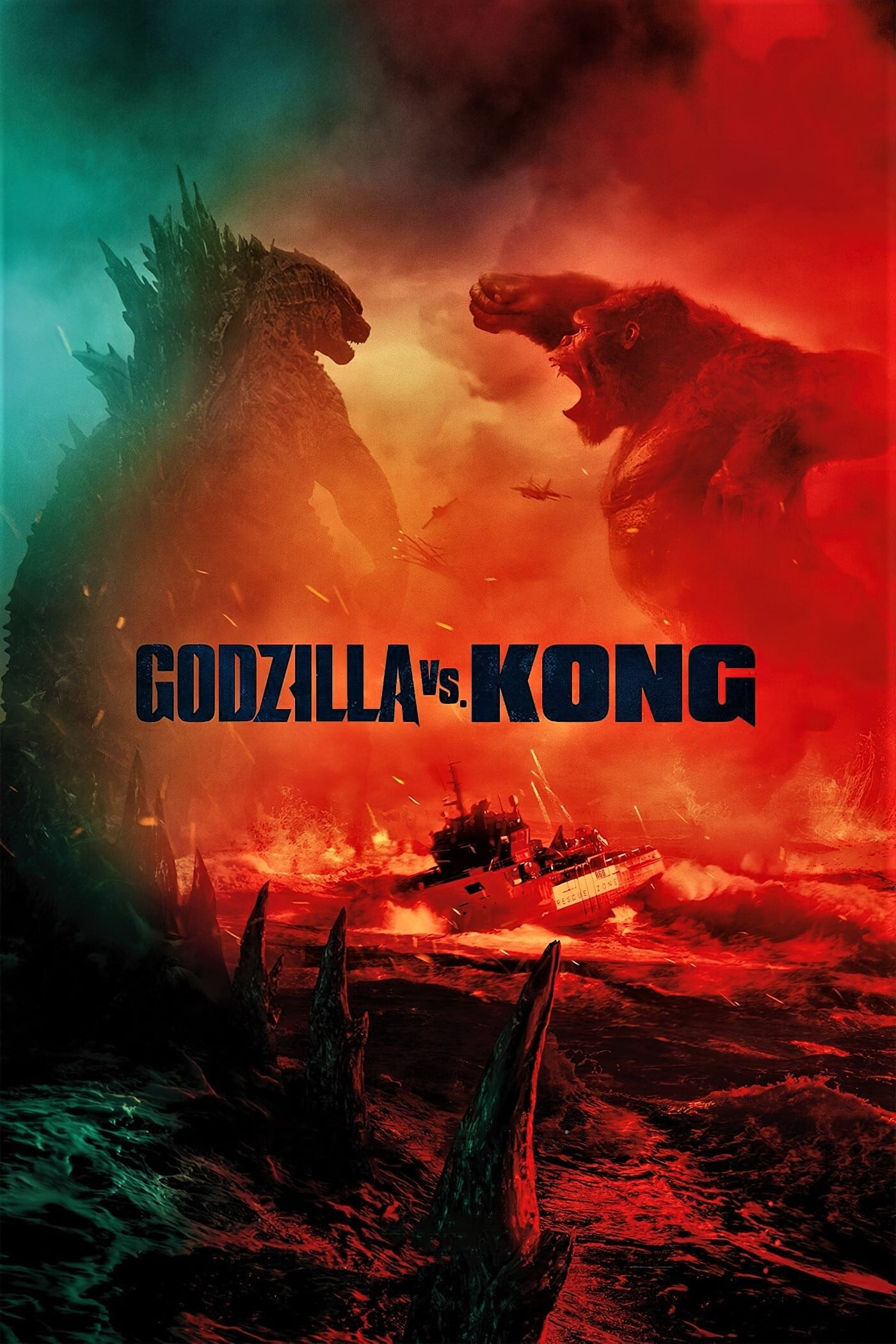
Adam Wingard, the director, is incredibly dedicated to his work and knows exactly what spectators are paying to see. The story of the movie is organized around three main set pieces, each of which gets bigger and more ridiculous.
The rules of engagement are instantly established as Godzilla ambushes Kong's navy transport in the ocean confrontation. Water gives the atomic lizard the upper hand; Kong battles valiantly from a sinking aircraft carrier as the ocean turns against him. Instead of just using monster posturing, the underwater imagery in this sequence, which shows Godzilla's dorsal fins slicing through the dark water like shark fins from hell, builds real suspense through the surroundings.
- The Hong Kong finale is the epitome of contemporary blockbuster cinema. Vertical battlegrounds are provided by neon-soaked skyscrapers; as both titans launch themselves through buildings, subway networks, and ultimately the planet's hollow core, gravity becomes optional. You can always tell where the fighters are in relation to one another and the crumbling cityscape because Wingard films with a geographic clarity that is uncommon in destruction porn.
- Above all, the movie earns its title fight. Godzilla and Kong actually try to kill each other, with obvious winners emerging from each fight; this is not a quick skirmish before an alliance. Three decisive battles are presented to the audience, each with its own choreography and emotional stakes.
Legendary's MonsterVerse has consistently delivered iconic kaiju redesigns, and this installment refines that legacy.
- With scar tissue evident across his scales and eyes blazing with territorial wrath, Godzilla looks bulkier and more armored than when he was first introduced in 2014. His dorsal plates, a visible indicator of his atomic might, light brighter and brighter. The movie depicts his breath weapon charge as a catastrophic catastrophe, with entire city blocks glowing with blue death.
- The more extensive redesign is given to Kong, who keeps his expressive facial features while being enlarged to competitive proportions. His battle wounds, graying fur, and obvious weariness all point to decades of survival. His monkey agility—climbing, grappling, and using tools—is highlighted in the movie, providing visual contrast to Godzilla's reptile bulk. Kong is physically outmatched and is aware of it; his eyes, especially when viewed up close, exude intellect and frustration.
- Mechagodzilla stands for industrial horror in opposition to organic grandeur; it was first shown in marketing but is presented as a third-act surprise. Its skull-based control mechanism and jerky, puppet-like movements—which are purposefully unsettling—indicate a technological transgression of natural order. The design visualizes the film's themes of human arrogance by practically incorporating Ghidorah's DNA.
Secondary creatures—the Warbats, the Hellhawks, the skeletal remains of Kong's ancestors—populate the Hollow Earth with sufficient variety to suggest ecosystem rather than mere monster warehouse.
Instead of focusing on realistic animal behavior, Wingard treats Titan Combat as martial arts film. Godzilla uses tail-whip strikes and sumo-like charges, while Kong assumes boxing postures. Character is reflected in their styles: Godzilla is the elemental force, and Kong is the improvised brawler.
- The intricacy of the choreography in the Hong Kong battle is especially noteworthy. Kong answers with aerial evasion and drop-kicks as Godzilla uses atomic breath to slice the radio tower he uses as staff. Every fighter adjusts; Kong learns to turn off Godzilla's breath-charge, and Godzilla attacks Kong's injured shoulder. The altercation unfolds like a skyscraper chess game.
- The choreographic logic is maintained even in the Mechagodzilla confrontation. Teamwork is necessary due to the mech's superior speed and armament; Kong's axe-combination and Godzilla's atomic pulse call for particular tactical collaboration. The "team-up solves everything" cliche is avoided in the movie; despite their unity, the titans fight against human-engineered perfection.
The MonsterVerse has consistently invested in world-building beyond creature creation, and this installment expands that vision significantly.
- The film's visual focal point is the Hallow Earth section, which depicts an inverted primordial earth with bioluminescent vegetation illuminating impossibly complex structures and gravity acting in accordance with dream logic. The remnants of Kong's species encircle his throne room, suggesting millennia of history devoid of explanatory discourse. The most truly amazing scene in the movie is Kong climbing through a revolving sky with stars and stone switching positions thanks to the anti-gravity "threshold" between surface and core.
- The neon-lit colosseum in Hong Kong is ideal for fighting monsters at night because of its verticality and light density. Glass towers and lit facades are examples of the production design's emphasis on transparency, which enables viewers to follow the destruction through architectural cross-sections. We watch as the damage spreads floor by floor as Godzilla's breath rips through buildings.
- Even Apex Cybernetics facilities are given a unique visual identity: the mech-construction chamber's scale and geometric accuracy evoke 2001's monolith, while brutalist concrete suggests institutional secrecy.
The audio landscape deserves recognition as character rather than effect.
- Refined from the vibration-based version from 2014, Godzilla's roar blends nuclear wind and animal bellow, with sub-bass frequencies that literally shake theater seats. With each hit recorded as a geological event rather than just weight, his approach is signaled by footstep percussion.
- Kong's vocalizations highlight primate intellect, such as his frustrated grunts, challenging howls, and the infrequent, nearly human-like grief he felt when seeing his ancestral home. His emotional moods are differentiated by the sound design using only auditory texture.
- The axe's contact with Godzilla's atomic breath produces harmonic resonance that becomes a plot point, ancient creatures vocalize in frequencies suggesting immense scale, and reversed gravity produces reversed doppler effects, all of which contribute to the immersive aural architecture of the Hollow Earth environment.
The MonsterVerse's dedication to tactile audio is upheld by the sound design team of Erik Aadahl and Ethan Van der Ryn; each collision registers as material (flesh, bone, concrete, metal) rather than a generic explosion.
The human cast exists exclusively to transport monsters between locations, and the film makes minimal effort disguising this utility.
- With no change or repercussion, Madison Russell (Millie Bobby Brown) replicates her King of the Monsters arc—adolescent looking into conspiracies. Her collaboration with Josh Valentine (Julian Dennison) relieves stress with humor; their intrusion into Apex headquarters unfolds with the ease of a sitcom rather than the suspense of a thriller.
- Without interiority, Nathan Lind (Alexander Skarsgård) personifies the "handsome scientist" cliché. Despite being addressed twice, his deceased sibling does not elicit any emotional response. Instead of registering as a human connection, his attraction to Ilene Andrews (Rebecca Hall) registers as a script obligation.
- Only Bernie Hayes (Brian Tyree Henry), with his paranoid podcaster who delivers information with enough quirky passion to detract from its mechanical function, manages to attain memorability through pure performance commitment.
- The most obvious flaw in the movie is that Jia (Kaylee Hottle), the deaf Iwi girl who speaks to Kong, ought to act as an emotional support system. Rather, she and Kong continue to have a surface-level relationship based on sign language exchanges that provide information rather than demonstrating a bond. The scene attempts for King Kong tragedy when Kong reaches for her in the ending, but instead ends up as an obligatory rhythm.
The narrative operates as delivery system for spectacle, and its contortions become increasingly visible.
- Screenwriting by checklist is represented by the Hollow Earth energy source, which is required to power Mechagodzilla and was found via antigravity maps and retrieved by Kong's ancestral wisdom. Instead than emerging from a cohesive world-logic, each story point serves to facilitate certain picture. Why is this particular energy required by Apex? Why does Kong work with people who have held him in the past? The movie shrugs and continues.
- Mechagodzilla's radiation signature is used to explain his Godzilla aggression—attacking facilities, presumably malevolent—but this information is revealed too late to excuse his previous city-destroying rampage. Godzilla is portrayed in the movie as an antagonist and then a victim without meriting either role.
- The film chooses not to examine the body-horror implications of Ghidorah's skull controlling Mechagodzilla, such as consciousness surviving decapitation and technical necromancy. The execution is still a Saturday morning cartoon, but the premise hints at Alien or The Thing territory.
The film's components exist in quality suspension, never achieving unified vision.
- Visual effects fluctuate between video-game artificiality (background destruction, Hollow Earth animals) and lifelike marvel (Godzilla's scales in close-up, Kong's facial expressions). The night sequences in Hong Kong are cohesive due to ambient obscurity, while the daylight sequences, especially the water fight, suffer from flat lighting that highlights CGI seams.
- Modulation is not used to change the tone. Walter Simmons (Demián Bichir) plays mustache-twirling villainy; Jia's communication with Kong strives for spiritual transcendence; and Madison's conspiracy probe plays as wide comedy. Scene upon scene, these registers just coexist without speaking to one another.
- The presence of monsters takes precedence over human coherence in Pacing. Forty minutes are devoted to the Hollow Earth expedition; montage is used to highlight character connections. The outcome seems both overcrowded (too many places, too many people) and undernourished (no emotional thread to tie the show together).
Godzilla vs. Kong is exactly what its title suggests: two legendary monsters smashing each other over large cities with skill and sometimes poetic visuals. The movie is entirely satisfying for viewers who are looking for kaiju fighting as the main draw.
The movie signifies franchise degradation for viewers looking for the atmospheric horror of Godzilla (2014) or the emotional impact of Kong: Skull Island. The MonsterVerse has steadily replaced wonder with spectacle, suggestion with evidence, and mystery with clarity. The monsters are now personalities to be rooted for rather than forces of nature to be observed, and their conflicts are staged entertainment rather than catastrophic happenings, which completes that trend.
Although Wingard is a director who loves genres and has a creative eye for visuals, he is unable to overcome screenplay flaws that portray people as obnoxious distractions rather than emotional pillars. The end product is a movie with amazing elements that never come together to form an amazing whole—a mythological theme park attraction.
Staff:
Directed by: Adam Wingard
Written by: Eric Pearson and Max Borenstein
Story by: Terry Rossio, Michael Dougherty, and Zach Shields
Based on: Godzilla and Mechagodzilla by Toho Co., Ltd.
Produced by: Thomas Tull, Jon Jashni, Brian Rogers, Mary Parent, Alex Garcia, and Eric McLeod
Starring: Alexander Skarsgård, Millie Bobby Brown, Rebecca Hall, Brian Tyree Henry, Shun Oguri, Eiza González, Julian Dennison, Lance Reddick, Kyle Chandler, and Demián Bichir.
Cinematography: Ben Seresin
Edited by: Josh Schaeffer
Music by: Tom Holkenborg
Production companies: Legendary Pictures
Distributed by: Warner Bros. Pictures (Worldwide) and Toho-Towa (Japan)
Release date: March 31, 2021
Running time: 113 minutes


Comments
Post a Comment