Doctor Strange in the Multiverse of Madness
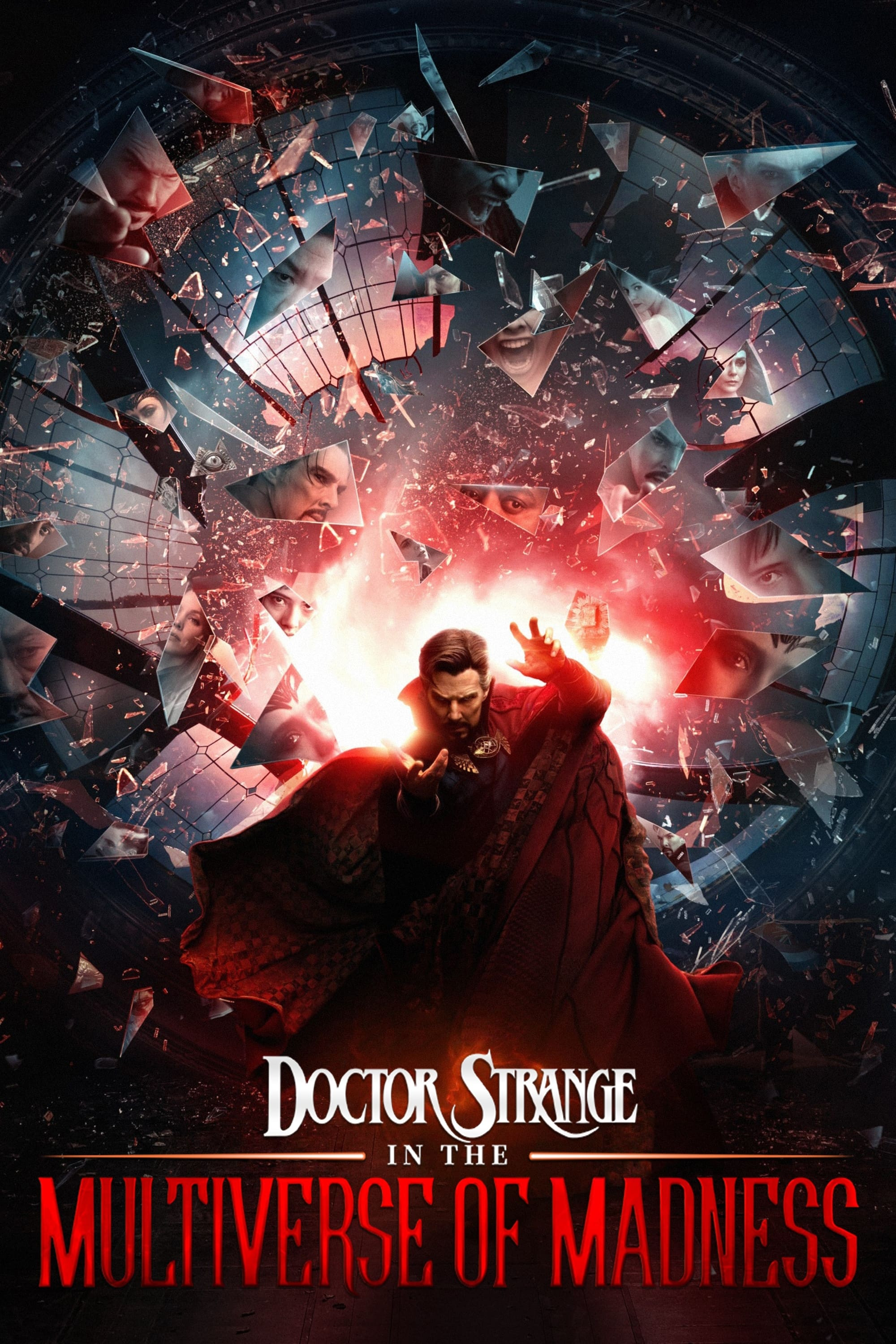
By creating set pieces that put personality over pixel count, Sam Raimi gives the MCU a much-needed boost of visual innovation. A ponytailed Defender Strange and America Chavez running from a ribbon demon in the opening chase through the void between universes creates a fast-paced, terrifying atmosphere right away. Particularly during Wanda's siege on Kamar-Taj, when she moves with a terrible, smooth purpose, the hand-to-hand fighting has visceral weight. The "wavy, sketchy" magical trails, the subjective camera work that flies among universes, and the practical-meets-CGI aesthetic that gives magic a tactile rather than weightless sensation are some of Raimi's most memorable scenes. Each realm is differentiated by vivid color schemes and odd landscape, and the sequence of multiverse hopping, in which Strange and America crash through more bizarre realities, offers true visual amazement.
Raimi creates terrifying scenes that feel out of place in the mostly family-friendly MCU, taking it into truly frightening territory. Its use of "gallows humor" and "tortured souls, undead entities, rapid fly-about camera tricks" is more reminiscent of Evil Dead than Avengers. The most powerful horror scene in the series is a shadow racing past a doorway, followed by a blood-covered body emerging in a jump fright. A particular skull eruption "certainly stuck with me" as shockingly grisly for PG-13, demonstrating the unexpected weight of the violence. Here, magic corrupts, the cosmos provides endless horrors instead of endless wonder, and the Scarlet Witch transforms into a natural force that "makes her a force to be reckoned with"—all of which are products of this darkness. This change in tone feels "wildly refreshing" to viewers who are drawn to superhero material that involves danger and consequence.
The film avoids franchise anonymity thanks to Raimi's authorial fingerprint. The film "feels a lot like Evil Dead 4" because to his trademark techniques, which include whip-pans, Dutch angles, an unrelenting subjective camera, and the mingling of humor with horror. Raimi employs "mise-en-scène and timing to create sustained dread and surprising scares that feel cinematic rather than videogame-like"; no other MCU film looks or moves like this. The director's decision to accept "genuine weirdness rather than sanitize it" leads to scenes that no algorithm could produce, such as the musical note fight, the spirits of the damned, and the zombie Strange. Raimi's visual storytelling keeps viewers interested even when the writing falters, demonstrating that director-led superhero movies can still have unique personalities inside the MCU.
Instead of using excess, the terror elements are successful because they are precise. Raimi is aware that horror is evoked by anticipation—the passing shadow, the creaking door, the unexpected arrival of the Scarlet Witch wearing a nightgown soaked in blood. They "keep you on your toes" without overpowering the heroic structure. Raimi's command of timing and spatial awareness is evident in the film's most effective scare, which is Wanda's abrupt emergence when a shadow speeds past. These horror moments focus on traditional approach, with lighting, sound design, and camera movement all working together to generate authentic discomfort, in contrast to the CGI-heavy climaxes that are common in the genre.
The way the movie handles its characters, especially Wanda Maximoff, is its biggest flaw. Following one of the most complex examinations of grief in the MCU by WandaVision, in which Wanda processes loss and finally decides to destroy her fantasy world rather than hurt others—This growth is completely erased by Multiverse of Madness. She turns into a "one-note, one beat, tired trope of a villain whose entire arc boils down to: I'm not a monster, I'm a mother". We are expected to accept her murderous rampage based on a single post-credit scene from WandaVision, even though the film claims that the Darkhold corrupted her but never depicts this decline.
"Largely the same, exhibiting the same carelessness about magic as he has always had" is how Doctor Strange describes himself. Learning to let go of Christine is his path, although it feels more like "a minor subplot at best" than a significant development. America Chavez essentially acts as a McGuffin, with her "development" being a motivational speech that repairs her confidence. The movie "forgets to give the characters save for Wanda any real development," rendering them "ciphers in visual effects showcases".
Emotional investment is hindered by the narrative's frenzied intensity. "The pacing moves quickly and, while there is never a boring moment, there are several points where the story could have slowed just a bit to allow for more relationship building amongst characters". Without giving scenes time to develop, the movie jumps from set piece to set piece, from Mount Wundagore to the Gap Junction to the Illuminati realm to the Kamar-Taj. The film hopes that by keeping events in continual motion, audiences won't notice the lack of connecting tissue between emotional beats, so masking the thinness of the plot. It feels "rushed rather than earned," and character interactions assume intimacy that hasn't been developed in the writing.
A shockingly straightforward—and merely repetitive—narrative lies beneath the multiversal display. The storyline boils down to this: Wanda wants America's powers, Strange tries to stop her, they fight, Wanda temporarily prevails, and Strange uses the Darkhold to outwit her. In contrast to thematic inquiry, the multiverse is used as window dressing; although the title promises "madness," we only make brief visits to a small number of realities. The Illuminati segment serves just as a demonstration of Wanda's power before eliminating them, and even if it features fan-service cameos, it makes little thematic progress. Every expository dump concerning the Darkhold and the Book of Vishanti reveals the flaws in the screenplay, which Michael Waldron revised during production while Raimi was already filming. According to a critic, "the multiverse makes for a good playground, it still doesn't feel like it's being used to its full potential".
The film is the epitome of contradiction: artistically ambitious but narratively lazy, physically dazzling but emotionally hollow. Raimi's direction "casts an entertaining spell" that is unable to completely conceal the "sprawling MCU" weight that is holding it back. The action shines while the prose is unclear; the horror aspects excite while the character development irritates. Alongside speech that reduces deep suffering to cliched statements about motherhood, Elizabeth Olsen's powerful performance—finding "whatever honesty the material is capable of possessing"—occurs. While the movie "is solid overall, if not particularly game-changing," it lacks the substance to make either of its "personality" and "imagination" memorable. Instead of being a coherent whole, the movie is made up of moments—the musical note war, the zombie Strange, and Wanda's horrific hallway walk—leaving audiences with breathtaking pieces that don't fit together to form a complete story.
It is demonstrated by Doctor Strange in the Multiverse of Madness that while a director's vision can improve franchise content, it cannot completely restore it. With its authentic horrors and explosive energy, Raimi's horror-comedy sensibilities provide the MCU's most visually striking entry. However, the film falls short of excellence due to its shallow, repetitious storytelling and disdain for character consistency, especially Wanda's development. The movie "could have been a slam dunk" but instead ends up being a "magically good time" that fades when you think about it. The stylistic flourishes make the ticket worth it for Raimi enthusiasts, but the emotional emptiness might be too high for others.
Staff:
Directed by: Sam Raimi
Written by: Michael Waldron
Based on: Marvel Comics
Produced by: Kevin Feige
Starring: Benedict Cumberbatch, Elizabeth Olsen, Chiwetel Ejiofor, Benedict Wong, Xochitl Gomez, Michael Stuhlbarg, and Rachel McAdams.
Cinematography: John Mathieson
Edited by: Bob Murawski and Tia Nolan
Music by: Danny Elfman
Production company: Marvel Studios
Distributed by: Walt Disney Studios Motion Pictures
Release date: May 6, 2022
Running time: 126 minutes


Comments
Post a Comment