Scarlet
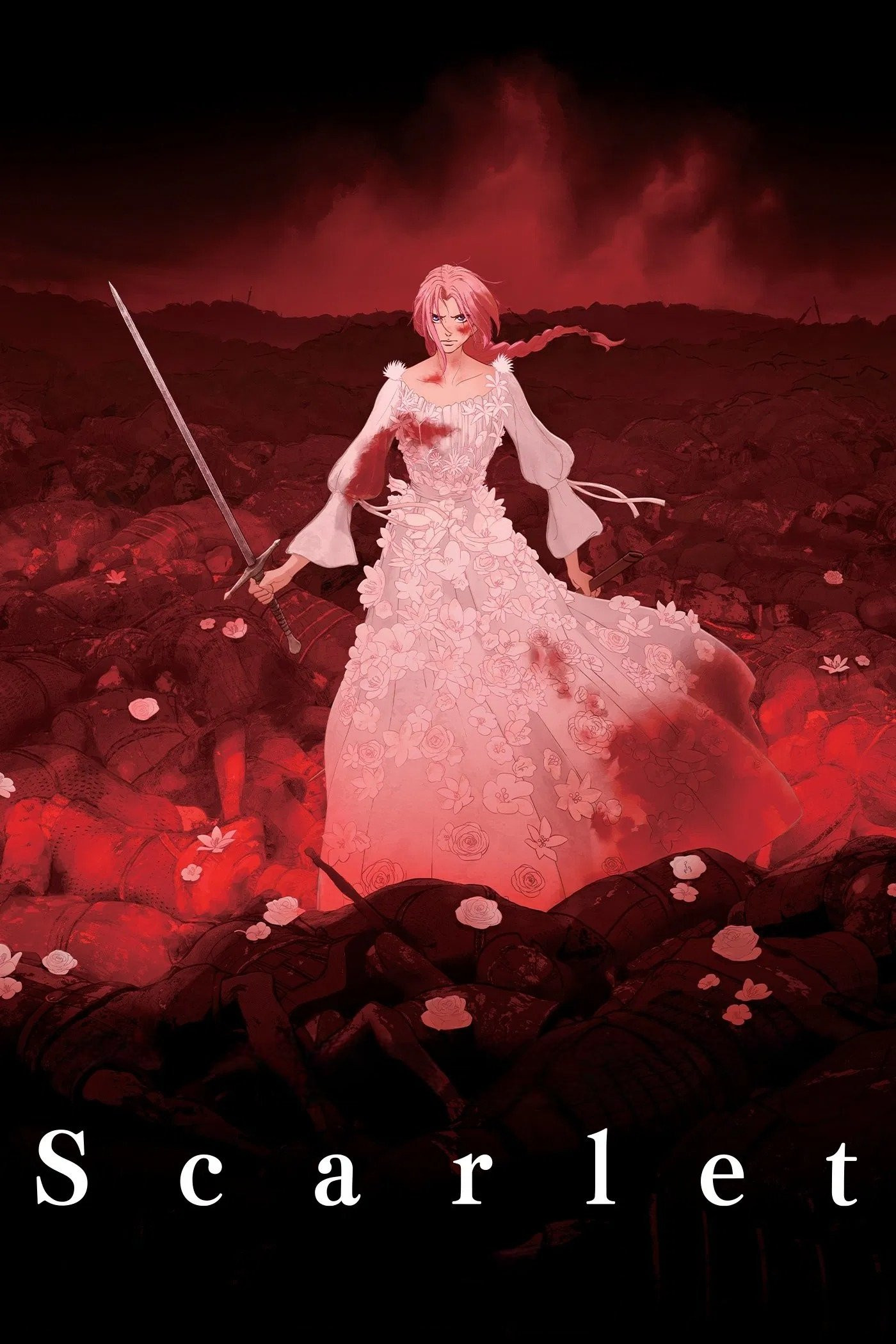
The new Mamoru Hosoda movie is the kind of ambitious misfire that is easier to admire than to love. The film reimagines Hamlet as a gender-swapped fantasy epic, following a 16th-century Danish princess who, after failing to avenge her father's murder and being poisoned by her uncle Claudius, awakens in a purgatorial realm called the Otherworld. There, she encounters souls from across time—including Hijiri, a modern-day paramedic whose stubborn pacifism clashes violently with her thirst for revenge. It is a bold premise, and Hosoda deserves credit for swinging for the fences.
The film's visual ambition is undeniable. Hosoda toggles between traditional 2D animation for the land of the living and 3D CG for the Otherworld, creating a stylistic duality that mirrors Scarlet's internal conflict between vengeance and forgiveness. The Otherworld itself is rendered with striking detail—vast desert landscapes, a sky that behaves like an ocean, and a massive dragon that patrols the wastes—offering some of Hosoda's most jaw-dropping imagery to date. The prologue in 16th-century Denmark, rendered in gorgeous hand-drawn animation, crackles with the gothic intensity of a classic revenge tragedy.
Where this movie falters are in its storytelling. The screenplay, written solely by Hosoda, rushes through its protagonist's transformation from a sheltered princess to a deadly swordswoman with such speed that her growth feels unearned. The central relationship between Scarlet and Hijiri, which should form the film's emotional core, is buried under heavy-handed moralizing about the futility of revenge. Their debates about violence and forgiveness grow repetitive, and Hijiri himself remains a flat, saintly figure whose pacifism is asserted rather than explored. The film's supporting characters, meanwhile, are largely reduced to nameless crowds or thinly sketched obstacles, leaving the Otherworld feeling vast but emotionally empty.
The 3D animation, while ambitious, proves to be a double-edged sword. In quieter moments, the Otherworld's landscapes are breathtaking. But during action sequences and crowd scenes, the CG character models veer into the uncanny valley, their movements feeling disconnected from the detailed environments around them. A pair of dance sequences—including a baffling La La Land-inspired fantasy number—are particularly jarring, their awkward choreography undermining the film's emotional aspirations.
Most frustrating is the ending, which attempts to resolve the film's themes of vengeance and forgiveness with a sweeping, almost naive declaration about ending war forever. It is a conclusion that feels both unearned and oddly disconnected from the intimate, grief-stricken drama that preceded it. For a director of Hosoda's caliber—the mind behind Wolf Children and Belle—this movie plays like a collection of stunning ideas that never quite cohere into a satisfying whole. It is a film that reaches for the stars and stumbles somewhere in the stratosphere.
A visually breathtaking but narratively muddled adaptation that proves Hosoda's imagination remains boundless, even when his storytelling cannot keep pace.
Staff:
Directed by: Mamoru Hosoda
Screenplay by: Mamoru Hosoda
Story by: Mamoru Hosoda
Produced by: Nozomu Takahashi, Yuichiro Saito, and Toshimi Tanio
Starring: Mana Ashida, Masaki Okada, and Koji Yakusho
Edited by: Shigeru Nishiyama
Music by: Taisei Iwasaki
Production companies: Studio Chizu, Nippon Television, and Sony Pictures
Distributed by: Toho and Sony Pictures Entertainment Japan
Release date: November 21, 2025
Running time: 111 minutes


Comments
Post a Comment