Madame Web
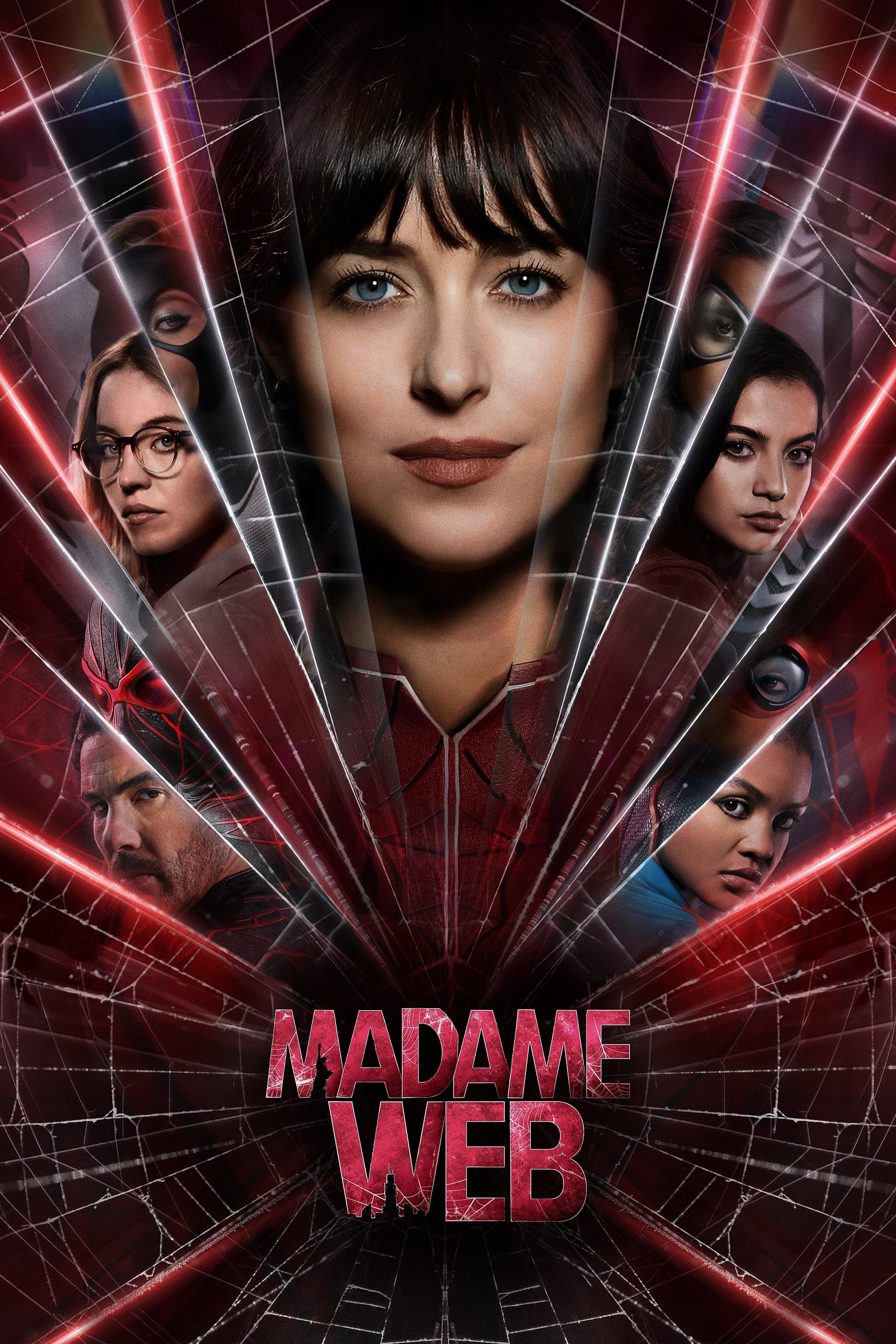
A film so radically flawed in its conception and execution that it goes beyond simple disappointment to become something almost interesting in its failure, Madame Web stands as a warning in the increasingly crowded field of superhero movies. Cassandra Webb, a paramedic who has clairvoyant skills, is the focus of S.J. Clarkson's Sony Spider-Man Universe entry, which tries to start a new franchise but fails due to its inherent incoherence. Instead of the "psychological thriller" that was advertised, we get a confused, incompetent production that falls short on almost every level of filmmaking artistry, from its wooden performances to its glacial pacing, from its stilted conversation to its unintelligible action. It is a catastrophe by almost every measure.
Ironically, Madame Web's strange type of engagement is achieved by the overwhelming spectacle of its dysfunction rather than by quality. There are brief, unintentional moments when the film's ineptitude creates a kind of hypnotic allure. Every now and again, Dakota Johnson's deadpan delivery verges on deliberate humor, her seeming indifference to the subject matter producing an inadvertent meta-commentary on the ridiculousness of the movie itself. Her flat intonations of phrases like "I think I'm in the Amazon," which result from the disconnection between context and performance, create a weird humor that the writer most definitely wasn't going for.
These times, however, are islands in a sea of boredom. There are twenty moments of agonizing exposition, with characters elaborating on plot issues that make no sense no matter how much they are clarified, for every unintentionally funny line delivery. The movie's level of involvement swings wildly between "so bad it's entertaining" and "so boring it's unendurable," never settling into either category long enough to provide steady enjoyment. Even the satirical delight fades by the third act, giving way to the heartbreaking knowledge that almost two hours have been devoted to a story that ends with a group of women gazing at a spider in a glass exhibit.
Madame Web's action scenes are among the worst done in contemporary superhero movies. Madame Web provides only confusion in contrast to movies like Mad Max: Fury Road or even Sony's own Venom entries, which exhibit kinetic clarity and spatial intelligence. Fans describe the set pieces as "boring, badly edited, and poorly choreographed," and the "worst green screen" effects they've seen in their lifetimes. The main idea of the movie—Cassandra having glimpses of potential futures—should allow for imaginative action design, giving viewers a chance to experience several possible outcomes before the "real" one takes place. Rather, Clarkson employs this mechanism in an arbitrary manner, alternating between timeframes so frequently that stakes and spatial linkages are rendered entirely unclear.
The highly debated scene with the Pepsi sign is representative of the movie's action shortcomings. Poor editing and effects work turn what should be a suspenseful moment into inadvertent comedy. Characters engage with computer objects that never attain physical presence while moving through locations that are obviously nonexistent. There is no rhythm, escalation, or consequence to the action; falls happen without gravity, punches land without impact, and the final confrontation—involving three young women who have been trained for just fifteen minutes—resolves through narrative convenience rather than merited victory.
For the duration of the movie, Cassandra Webb's character arc, as it exists, stubbornly stays flat. She starts out as a paramedic who struggles with commitment and motherhood, and she ends up as a superhero who also struggles with these same difficulties, but now she's wearing a red leather jacket. The movie conflates backstory with growth, giving Cassandra's mother's studies in the Amazon in great detail without relating it to any significant shift in the present. She comes to accept her abilities, but this acceptance seems more like a story device than a psychological development, and it feels more mechanical than emotional.
Even terrible are the three young women she defends: Anya Corazon (Isabela Merced), Mattie Franklin (Celeste O'Connor), and Julia Cornwall (Sydney Sweeney). They serve as interchangeable victims, only set apart by their eventual superhero identities (teased in a future that is probably never going to come) despite the movie's marketing pitching them as a team. Instead of developing through earned trust, their relationships with Cassandra are shaped by narrative fiat; they go from being hostages to surrogate daughters without any real connection in between. We have never been persuaded of their humanity, much less their heroism, so the film's last scenes, in which they are dressed in comic-accurate costumes, fall with a thudding irrelevance.
Matt Sazama, Burk Sharpless, and Claire Parker are credited with writing the screenplay, which is a masterclass in character dialogue done wrong. Characters give exposition with the nuance of a Wikipedia synopsis, repeatedly explain plot mechanics ("You're having visions of the future"), and openly state their objectives ("I don't need anyone"). Every character, regardless of age, background, or emotional condition, speaks in the same declarative, functional mode, and the conversation is devoid of subtext, rhythm, and personality. The sentence "You're going to be a great uncle," which Cassandra says to her paramedic partner Ben Parker (Adam Scott), lands with such thudding obviousness—yes, that Ben Parker—that it evokes moans instead of recognition.
This material is not elevated by S.J. Clarkson's direction, nor is any cohesive visual identity imposed. The tone of the movie veers wildly between humor, drama, and thriller without following any genre's standards. Crucial plot moments are rushed past in confusing montage, and the pacing is "glacial," with scenes lasting much beyond their narrative utility. Although Madame Web appears and feels like a television pilot that has been mysteriously stretched to feature length and given a theatrical budget it doesn't know how to employ, Clarkson's expertise in television—specifically, fashionable programs like Jessica Jones—suggested potential for atmospheric narrative.
The most talked-about aspect of the movie is Dakota Johnson's performance, but not in a way that any of the actors would like. Brilliant subversion and career sabotage have been many interpretations of her seeming detachment from the material—delivering lines with flat affect, keeping physical distance from her co-stars, creating an aura of barely veiled scorn for the entire operation. The truth is probably somewhere in the middle: Johnson, who is a competent performer when given good material, saw the shortcomings of the script and opted for simplicity rather than ebullient failure. As a result, the protagonist appears to be continuously taken aback by her own film, responding to paranormal occurrences with the annoyance of someone whose Uber has been delayed.
Likewise, the supporting cast struggles. Sydney Sweeney, who was so captivating in Euphoria and The White Lotus, is relegated to appearing worried in different places. As the antagonist Ezekiel Sims, Tahar Rahim plays a guy whose motivations—he wants to kill the girls because he saw them kill him in a vision—remain stubbornly abstract. He delivers his lines with an accent that shifts between locales. Though his portrayal of Uncle Ben Parker is so obviously franchise setup that it elicits more eye rolls than emotional engagement, only Adam Scott comes off largely undamaged, his inherent charisma momentarily bringing life to otherwise dull passages.
Madame Web is fundamentally flawed due to its writing's inability to weave stories effectively. For the sake of the plot, Cassandra's power rules are established, disregarded, and then reestablished. The villain's level of threat varies greatly; he can kill skilled agents and be vanquished by a falling sign at the same time. The main emotional bond in the movie—between Cassandra and her mother—relies more on exposition and flashbacks than on actual connection, which makes the final reconciliation seem unearned.
The screenplay's attempts at thematic depth—examining finding family, female empowerment, and fate versus choice—remain wholly theoretical and are only ever mentioned by characters in the narrative. There is no catharsis when Cassandra ultimately accepts her role as Madame Web, replete with costume and superhero moniker, because we are only ever told what she is rejecting and never seen what she is accepting.
Madame Web is a failure of fundamental filmmaking skills, not just a terrible superhero movie. As proof that studios can spend millions on properties they don't understand, produced by filmmakers who appear to have lost faith in their own material, it enters the disgraceful ranks of Catwoman and Elektra. The movie's shortcomings are the only source of its level of involvement; viewing it becomes into an anthropological study in figuring out what went wrong, scene by scene, line by line.
However, its tragedy has a certain poignancy to it. Madame Web feels handcrafted in its ineptitude, the result of individual poor choices rather than corporate standardization in an age of algorithmic franchise management. Unlike many good but forgettable blockbusters, it will be studied, ridiculed, and remembered for a very long time. Depending on how one defines cinematic immortality, this may or may not be a success. Cassandra Webb, who was cursed with the power to see into the future, must have been terrified of how her own film would be received.
Staff:
Directed by: S. J. Clarkson
Screenplay by: Matt Sazama, Burk Sharpless, Claire Parker, and S. J. Clarkson
Story by: Kerem Sanga, Matt Sazama, and Burk Sharpless
Based on: Marvel Comics
Produced by: Lorenzo di Bonaventura
Starring: Dakota Johnson, Sydney Sweeney, Isabela Merced, Celeste O'Connor, Tahar Rahim, Mike Epps, Emma Roberts, and Adam Scott
Cinematography: Mauro Fiore
Edited by: Leigh Folsom Boyd
Music by: Johan Söderqvist
Production companies: Columbia Pictures, Marvel Entertainment, and Di Bonaventura Pictures
Distributed by: Sony Pictures Releasing
Release date: February 14, 2024
Running time: 116 minutes


Comments
Post a Comment